As a Sunday school teacher, I have often had to answer difficult questions arising from the book of Proverbs and other Wisdom literature. Many times, students would point to a proverb and ask,
“But isn’t this verse always true?”
Looking back, I realize that I sometimes struggled to provide satisfactory answers because I had not yet understood an important principle of interpreting Wisdom literature.
I assumed that every Proverb was an absolute promise from God.
As a result, whenever a learner presented an exception to a proverb, I found myself trying to explain away the exception instead of recognizing that I had misunderstood the nature of Wisdom literature.
The turning point came when I learned that
Proverbs teaches us how life normally works in God’s moral order.
It presents general principles and observable patterns, not guarantees that admit no exceptions.
For example:
Proverbs 22:6 says:
“Train up a child in the way he should go, and when he is old he will not depart from it.”
Many parents have faithfully taught their children the ways of the Lord, yet some of those children have still chosen to rebel against God.
Does this mean God’s Word has failed?
Certainly not.
Solomon is describing the normal pattern of life: children who receive godly training are generally more likely to remain on the right path.
The proverb is not denying that every person ultimately makes his or her own choices.
Another example is Proverbs 10:4:
“Lazy hands make for poverty, but diligent hands bring wealth.”
Generally speaking, diligent people are more likely to prosper than lazy people.
Yet we all know hardworking men and women who remain poor because of war, sickness, corruption, natural disasters, or economic hardship.
Likewise, some dishonest people become wealthy through fraud or exploitation.
Solomon is describing the normal pattern of life, not guaranteeing that every hardworking person will become rich.
As Bible teachers, we must therefore resist the temptation to treat every proverb as an unconditional guarantee.
Instead, we should ask,
“Is the author making an absolute promise, or is he describing the way life generally works?”
That simple question will prevent many interpretive errors and help us teach Wisdom literature with greater accuracy and confidence.
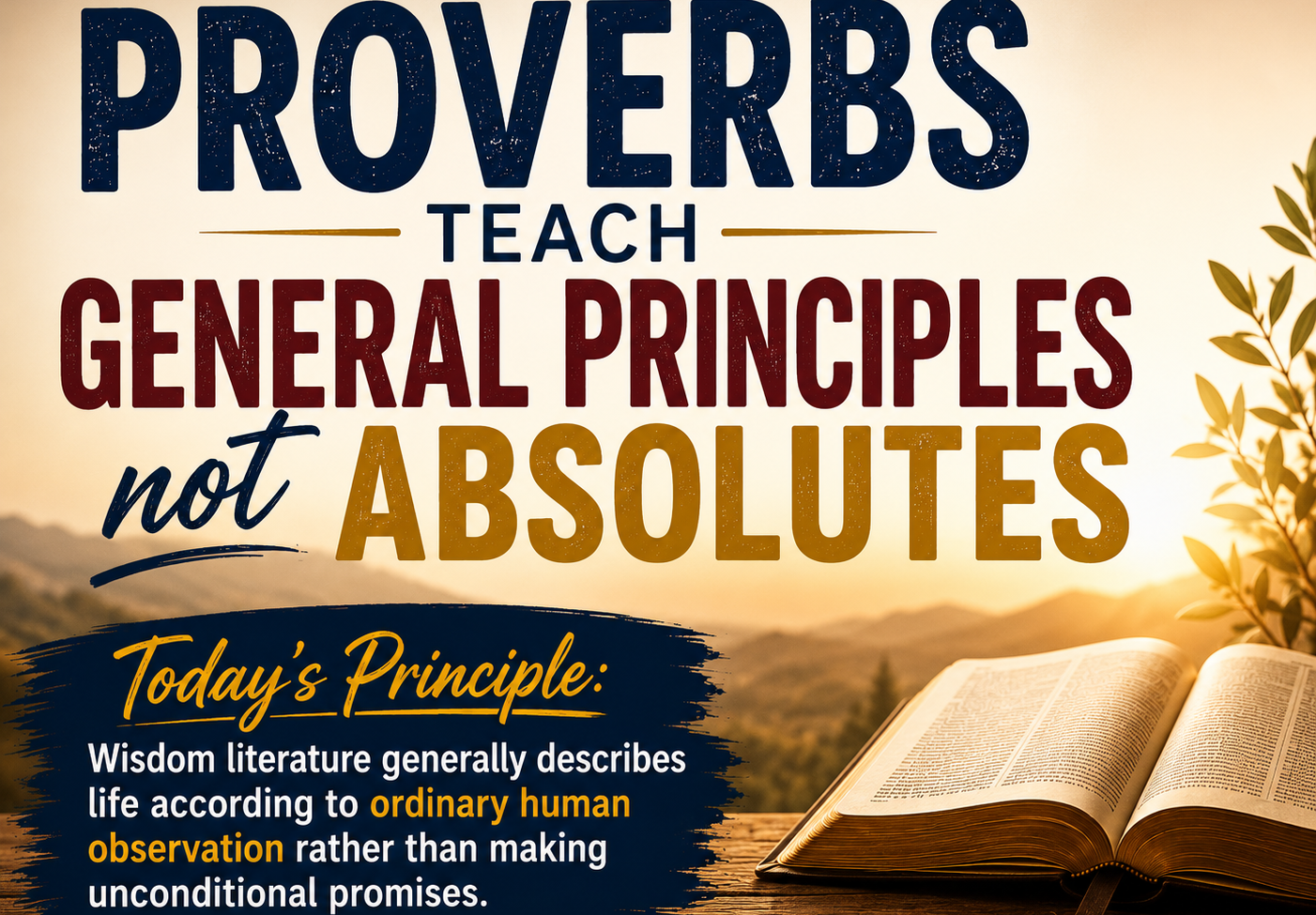
Today’s Principle:
Wisdom literature generally describes life according to ordinary human observation rather than making unconditional promises.

Whether in the classroom or teaching Scripture, he has a gift for taking difficult concepts and breaking them down into practical, understandable truths that people can grasp and apply. As a Bible teacher, Jini is committed to helping Christians understand God’s Word in its proper context, interpret it faithfully, and teach it with clarity and confidence.
View All Articles