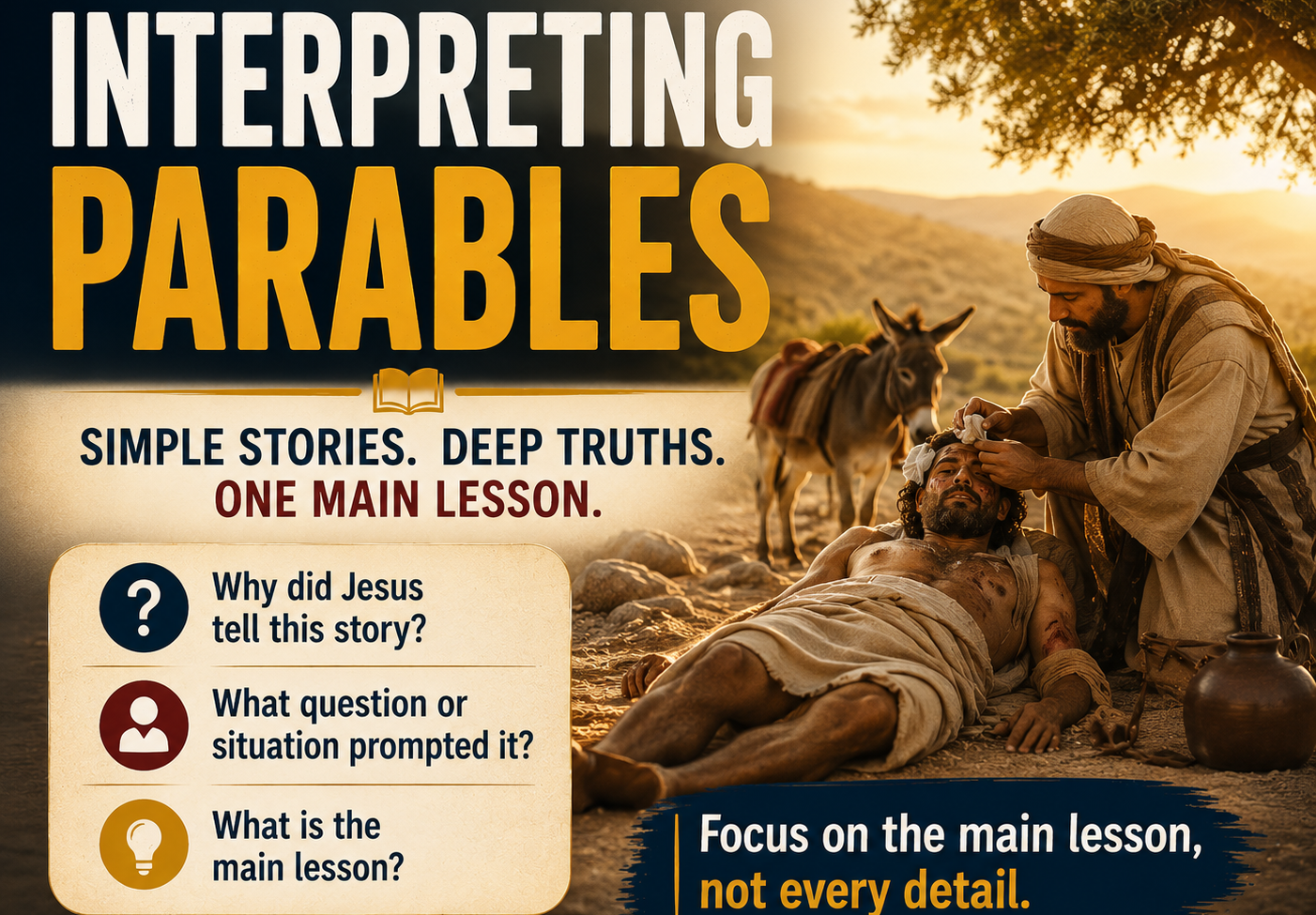
One of Jesus’ favorite teaching methods was the parable.
A parable is a simple story drawn from everyday life that illustrates a spiritual truth.
Many Bible teachers make the mistake of assigning spiritual meaning to every detail of a parable.
Generally, parables communicate one central lesson, although some contain a few supporting details.
For example, the Parable of the Good Samaritan (Luke 10:25–37) teaches what genuine neighbourly love looks like.
It is not intended to assign symbolic meanings to the donkey, the inn, the oil, or the coins.
When interpreting parables, ask:
Why did Jesus tell this story?
What question or situation prompted it?
What is the main lesson? This is often found at the end of His narrative- the climax of the story.
Avoid building doctrine upon minor details that Jesus never intended to emphasize.
For example
I personally used to think that Jesus told this parable just to teach us money and investment.
This is partly true because it can be an application from the text.
Jesus told this parable to prepare his disciples for his departure so that they can be accountable and responsible for the mission field while waiting for his second coming.
Motivational speakers and financial experts have taken the application of this text and dissected it out of proportion.
Today’s principle
Focus on the main lesson when interpreting parables not in every detail.

Whether in the classroom or teaching Scripture, he has a gift for taking difficult concepts and breaking them down into practical, understandable truths that people can grasp and apply. As a Bible teacher, Jini is committed to helping Christians understand God’s Word in its proper context, interpret it faithfully, and teach it with clarity and confidence.
View All Articles