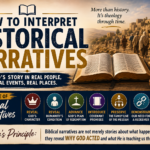
Suppose you read Psalm 98:8, which says,
“Let the rivers clap their hands, let the mountains sing together for joy.”
No responsible reader concludes that rivers literally possess hands or that mountains have vocal cords to sing.
Why?
Because we immediately recognize poetic language.
Poetry often communicates truth through imagery, metaphor, parallelism, personification and vivid description.
Its purpose is not to mislead us but to move our hearts and imaginations while revealing profound spiritual realities.
Now compare that with Luke’s Gospel. When Luke records that Jesus entered Jericho or that He spoke to Zacchaeus, he intends us to understand those events as real history.
The genre tells us how the author expects us to read the text.
Psalm 98 uses poetic imagery to celebrate God’s power and creation.
Luke, when narrating Jesus’ encounter with Zacchaeus, uses historical narrative and expects the reader to understand the event as something that actually happened.
Genre helps us know whether the writer is using poetry, historical narrative, prophecy, wisdom, parable, or another literary form—and therefore how we should interpret what we are reading.
In the days to come, we shall explore some books in the Bible written in a particular genre, to understand how to interpret that form of literature.
Today’s principle:
Recognizing genre protects us from both over-literalizing figurative language and symbolizing passages intended as historical facts.
Shei Jini
Eductor- Author
American School of Douala

Whether in the classroom or teaching Scripture, he has a gift for taking difficult concepts and breaking them down into practical, understandable truths that people can grasp and apply. As a Bible teacher, Jini is committed to helping Christians understand God’s Word in its proper context, interpret it faithfully, and teach it with clarity and confidence.
View All Articles